


A high-level recap
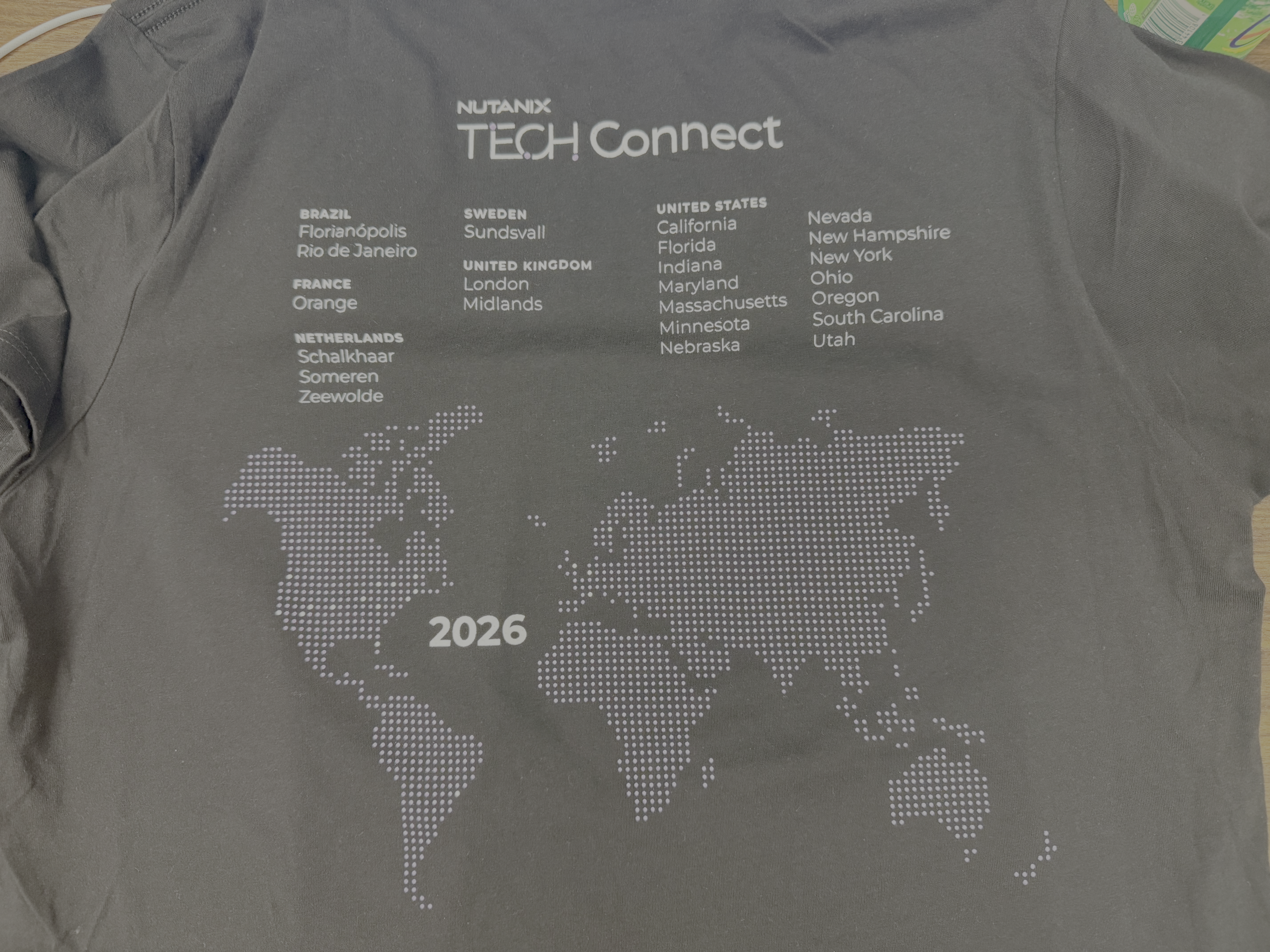
Finally there, day 1 of Nutanix Technology Champions Tech Connect 2026 (NTCTC), the invite-only summit for NTCs at Nutanix HQ, San Jose, CA.
While a lot happened in the weekend with people enjoying the San Francisco area and other ones dealing with delays, lost luggage the technology summit finally kicked off. If you want to read all the shenanigans the best place is the liveblog from Jeroen Tielen that started when we left Amsterdam.
Besides the great sessions (and yes, let’s be honest: the food from all over the world is a big part of it too 😄), Day 1 focused on Cloud-Nativce gave us a solid look at where NKP and the broader platform are heading. In this post I’ll share a high-level overview of what was presented during Day 1.
The day started with Angelo Luciani welcoming us at Nutanix HQ and ensuring we could got the meeting room where we got all the information directly from the Product Managers.
Built Together
Evolve Together
Opening keynote: The next chapter for Nutanix
The day kicked off with Thomas Cornely, EVP of Product Management, walking us through the journey from hyper-converged to cloud platform. A few points that stood out to me:
- NKP is a massive success story. After multiple organic attempts at containers over the years, the D2iQ acquisition finally brought the expertise and culture needed. NKP has now surpassed OpenShift and Rancher in customer count on Nutanix infrastructure.
- AI is where the company cannot afford to lose ground. The roadmap for calendar 2026 was deliberately reworked to invest heavily in infrastructure for AI, including GPU-optimized virtualization and agent workloads.
- VMs still have a role to play, especially for long-running autonomous agents that need data, permissions and high availability — much like the infrastructure we built for virtual desktops.
- The VMware exit wave is an opportunity, not just a threat. By embracing external storage and compute-only nodes (hello, dense GPU servers), Nutanix can now address a much bigger market while staying true to its core philosophy: break silos, make complex things simple.
Making NKP AI-ready: The “AI Factory”
One of the most interesting sessions – presented by Sonali Mishra (Principal Product Manager NKP)- was about how NKP is becoming an AI-ready platform. With almost 99% of AI workloads being containerized, this is clearly where the action is. Key highlights:
- CNCF AI Conformance — a sibling of the regular Kubernetes conformance certification, covering four pillars: accelerators (first-class GPU support), scheduling, networking/observability, and security/operators.
- The NKP AI Catalog — a curated set of AI/ML services you can deploy with a single click: NVIDIA and AMD GPU operators, the KAI scheduler (great at bin-packing GPU workloads), Slurm integration for HPC workflows, KServe and Envoy Gateway for inferencing/serving, JupyterHub, Kubeflow and Milvus.
- AMD GPU support — freedom of choice is real now. With the ongoing hardware shortage, first-class AMD support alongside NVIDIA is a welcome addition.
- Rayx Technologies acquisition — their IntelliScale product will be integrated into NKP for right-sizing AI workloads (initial benchmarks suggest 30-40% optimization), with plans to build a meta-scheduler that can decide whether a workload should run on Kubernetes or in an HPC environment.
- AI Navigator — the built-in chatbot, trained on years of support cases and KB articles. Think of it as an SRE-as-a-service for your fleet.
What’s new in NKP 2.19
Yannick (one of the the other NKP principal product managers) gave us a rundown of the latest release. The ones that stand out to me are:
- NKP Metal — this is huge. You can now run Kubernetes on bare metal, imaged via Foundation Central with a pre-hardened Ubuntu Pro image. My favorite part: you can mix virtualized and bare-metal node pools in the same cluster. So your control plane and regular workloads stay on AHV (optimal resource consumption), while GPU-dense physical machines are added for AI workloads — all managed from the same management cluster.
- Simplified, one-click upgrades — upgrades are now UI-based and declarative (GitOps-friendly), with pre-flight checks before and after the upgrade. No more mandatory bastion host for upgrades.
- Unified metadata registry — a single source of truth for all Nutanix container images, which finally makes it clear what you need in your firewall allow lists (a big win for air-gapped environments).
- Projects 2.0 support — full tenancy isolation at the PC level: VMs, PVs and OS images are all scoped to the project, making RBAC much simpler.
- AHV VM operator — define VMs as Kubernetes resources (yes, even Windows VMs) and manage them through GitOps. A nice step towards running your entire application stack from a single manifest.
On the storage side, Divyansh presented Cloud Native AOS, Nutanix’s storage subsystem for bare-metal environments, bringing all the AOS data efficiency features to NKP Metal — including RWX support for file shares. And NDK is becoming the unified data protection layer for everything: workloads on AHV, workloads on bare metal, and even the NKP management cluster itself.
NKP Insights: Security and observability at fleet level
A session I’d recommend everyone to look into: NKP Insights, the security and observability component included with NKP Ultimate. With 89% of organizations having experienced at least one container/Kubernetes security incident in the last 12 months, this is no longer a nice-to-have. It does CVE scanning (Trivy), CIS benchmarking, misconfiguration checks, upgrade blocker detection and certificate expiry alerts — now also including runtime security scanning with Falco (GA this December). Everything works fully air-gapped, and it gives you aggregated insights across your entire fleet from the management cluster. If you’re running more than a handful of clusters, config drift is a silent killer and this tooling helps a lot.
Designing resilient NKP topologies
Another practical session covered NKP cluster types and how to protect against various failure scenarios: management cluster loss (backed up via Velero to S3-compatible object storage), node failures, AHV host failures, EOS cluster failures and multi-datacenter setups. Key takeaways:
- Identify your failure domains first — do you want to protect against Kubernetes-level, AHV-level or site-level failures?
- Think layered — an application spread across Kubernetes nodes gains nothing if all those nodes land on the same AHV host.
- Persistent storage is the big question — in multi-site setups, storage is not replicated by default. Make sure your applications do application-level replication (or use NDK).
- Two data centers? The recommended approach is one Kubernetes cluster per data center with a load balancer on top, and NDK for replicating stateful workloads between them.
There’s no one-size-fits-all solution here, so it’s worth spending time on your application landscape before picking a topology.
Shaping the next decade of the NTC program
Since we are the Nutanix Technology Champions, there was also a workshop to shape the future of the program itself (“NTC 2036”). The idea: instead of a cookie-cutter advocacy program built around what the vendor wants, the program should be built around what we get out of it — better education, career growth and community recognition. We worked in groups on what makes the NTC distinctive, what membership should enable, and what tangible things should land within the next 12 months.
My personal highlights
As you can see, there was a lot packed into Day 1. The items that stand out to me personally are:
- NKP Metal with mixed node pools — running your control plane on AHV and only adding physical machines where you really need them (AI workloads) is exactly the flexibility I’ve wanted to offer customers.
- One-click upgrades with pre-flight checks — cluster upgrades being one of the top reasons customers stay on old Kubernetes versions for years, so this is a game changer for day-2 operations.
- NKP Insights — fleet-level security and observability out of the box, fully air-gapped capable.
- The AI Catalog — single-click deployment of a solid AI/ML stack, with real choice on GPU vendors.
A few roadmap items were shared under NDA, so I’ll keep those to myself for now 🙂 Stay tuned — Day 2 is next and there’s more to come!